Cooking for a Crowd: How to Double or Triple a Recipe Successfully
August 12, 2026
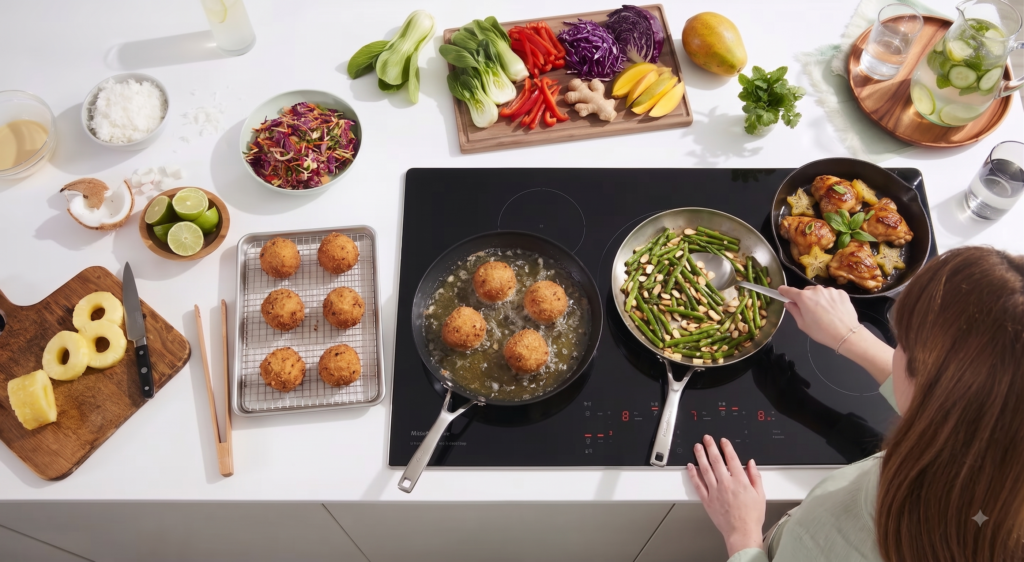
To double a recipe, multiply most ingredients by two, but scale salt, strong spices and leaveners by only 1.5x at first, then taste and adjust. Use a larger pan or split across several. Cook and bake times increase only slightly, so judge by doneness, not the clock. Mix in batches for very large amounts.
How to double a recipe is simple in principle: multiply every ingredient by two, but hold back on salt, strong spices and raising agents, then taste and adjust as you go.
- Multiply most ingredients by your factor, but start salt, spices and leaveners at 1.5x and taste before adding more.
- Use a larger pan or split the batter across two tins so it cooks evenly.
- Bake and cook times rise only a little — judge by doneness, not the clock.
Cooking for a crowd should feel exciting, not stressful. With a few sensible tweaks, your favourite recipe will feed twice or three times the people just as beautifully.
How do you double a recipe correctly?
The safe method is to multiply each ingredient by your scaling factor, then treat the tricky ones separately. Most flours, liquids, eggs, butter and sugar scale cleanly.
Salt, strong spices and raising agents do not always scale linearly. Multiply the reliable ingredients fully, but ease up on the assertive ones.
- Write out the original recipe in a single column.
- Multiply flour, liquid, fat, sugar and eggs by 2 (or 3).
- Multiply salt, spices, baking powder, bicarbonate and yeast by only 1.5 to start.
- Mix, then taste (for savoury) before adjusting seasoning.
For eggs, if doubling leaves you with a half egg, beat one egg and use roughly half by weight (a large egg is about 50g without shell). A calculator like our recipe scaler does this maths for you in seconds.
A real-world example
Say your brownie recipe uses 200g flour, 1 tsp salt and 1 tsp baking powder. Doubled, that becomes 400g flour, but I’d use ¾ tsp salt × 1.5 logic here.
Start with about 1½ tsp salt and 1½ tsp baking powder, then adjust. You can always add more; you cannot take it out.
Why don’t spices and salt scale evenly when doubling baking recipes?
Flavour perception is not linear. Twice the chilli or salt often tastes far more than twice as strong, tipping a balanced dish into harsh territory.
The same applies to bold spices like cloves, cinnamon and cumin. Start heavy spices and salt at 1.5x, taste, then build up gradually.
Leaveners behave differently again. Too much baking powder can leave a soapy, metallic taste and cause cakes to rise fast then collapse.
- Salt: 1.5x first, then adjust.
- Chilli, cloves, nutmeg: 1.5x, taste, add more.
- Vanilla, mild herbs: usually scale fully at 2x.
- Baking powder/soda: scale to about 1.5–1.75x for large batches.
What about the pan size and bake time when doubling?
This is where most crowd-cooking goes wrong. Twice the batter in the same tin will overflow or bake unevenly.
You have two good options: a bigger pan, or two pans of the original size. Splitting across two identical tins is the most reliable choice for cakes and traybakes.
Choosing a bigger pan
If you go larger, match the depth of batter to the original, not just the surface area. Doubling a 20cm round roughly suits a 28cm round, or a large rectangular tin.
Fill tins no more than two-thirds full to leave room for rise. Grease and line thoroughly, as larger bakes are harder to turn out.
How much longer will it take?
Bake time when doubling increases only slightly, not proportionally. A cake that took 30 minutes will not take 60 — more likely 35 to 45.
The oven heats the surface; a deeper bake simply needs a little more time to reach the centre. Always judge by doneness — a skewer test, internal temperature or a firm springy top — never by the clock.
| Situation | What to do |
|---|---|
| Doubled cake, one big tin | Add 20–50% to bake time, test early |
| Doubled cake, two tins | Keep original time, maybe +5 min |
| Doubled stew or sauce | Longer to come to the boil; simmer time similar |
| Doubled roast | Judge by internal temperature, not weight |
For roasts, a meat thermometer is your best friend. The Food Standards Agency lists safe internal temperatures worth checking for large joints.
How do you triple a recipe or scale up even further?
Knowing how to triple a recipe follows the same rules, with extra care for mixing and bulk. Large volumes behave differently from small ones.
Very large batters may not mix evenly in a standard bowl. For triple batches and beyond, mix in two or three separate batches, then combine gently.
- Use your biggest bowl, or a stockpot for wet mixtures.
- Cream butter and sugar in batches to keep air in the mix.
- Rest doughs and batters as usual — resting time does not multiply.
- For yeast doughs, check quantities with our yeast converter, as fresh and dried yeast differ.
When scaling recipes up, weigh rather than measure by cups for accuracy. If you only have volume measures, our cups to grams guide keeps large batches consistent (a US cup is 236.6 ml).
Common mistakes to avoid
- Doubling salt and spice blindly: the dish turns harsh. Fix: start at 1.5x and taste.
- Same tin, double batter: it overflows or sinks. Fix: use a bigger pan or two tins.
- Doubling the bake time too: you burn the outside. Fix: add 20–50% and test.
- Forgetting the middle egg: texture goes off. Fix: weigh a beaten egg for half quantities.
- Overloading the mixer: uneven crumb. Fix: mix in batches for large scales.
- Multiplying resting time: unnecessary waiting. Fix: keep rest times the same.
Does doubling affect cooking on the hob?
Yes, but mostly in timing to temperature, not cooking time itself. A doubled sauce takes longer to reach a simmer because there is more mass to heat.
Use a wider, heavier pan so the base isn’t crowded. Once bubbling, the simmering time stays close to the original recipe.
Stir more often, as larger volumes catch and scorch on the base more easily. Reduce sauces uncovered to concentrate flavour if they end up looser than expected.
The single most important tip to remember
Scale ingredients confidently, but treat salt, spices, leaveners and timing with a lighter, more watchful hand. Taste and test as you go, and you’ll rarely go wrong.
Have a favourite recipe you scale up for gatherings, or a tip that always works for you? Share it in the comments below, or ask a question — I’m always happy to help you feed a crowd well.
Try it yourself
Don’t want to do the maths by hand? Use our free tool below.
Frequently asked questions
Can I just multiply every ingredient by two when I double a recipe? Mostly yes, but not for salt, strong spices and raising agents. Multiply flour, liquid, fat, sugar and eggs fully, but start salt, spices and leaveners at 1.5x, then taste and adjust upward if needed.
How much longer does a doubled cake take to bake? Not double the time. In one large tin, add roughly 20–50% and test early with a skewer. Split across two original-size tins and the time stays almost the same. Always judge by doneness, not the clock.
How do I handle half an egg when doubling or tripling a recipe? Beat a whole egg and use half by weight. A large egg is about 50g without its shell, so roughly 25g is half. This keeps the moisture and binding balance correct.
Do I need a bigger pan or two pans when scaling a recipe up? Either works. Two identical tins give the most even bake and keep the original timing. A single bigger pan is fine if you match the batter depth to the original and fill no more than two-thirds full.