Fan Oven vs. Conventional Oven: How to Adjust Your Baking
August 5, 2026
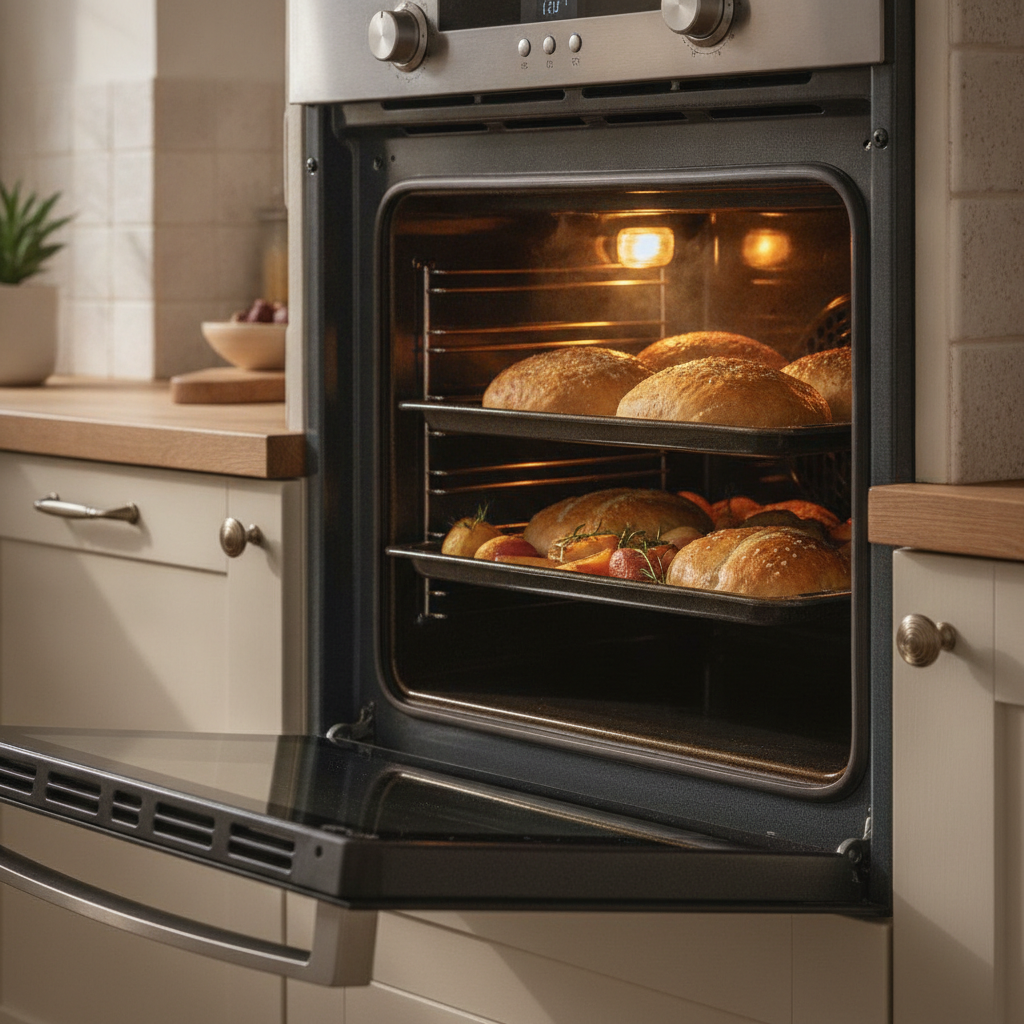
Fan oven conversion means lowering the temperature by about 20C (25F), so 180C conventional becomes 160C fan. A fan circulates hot air, cooking food faster and more evenly, which is why you reduce the heat to stop the outside browning before the inside cooks. Use fan for roasting and batch baking, conventional for delicate cakes.
For a reliable fan oven conversion, simply lower the temperature by 20°C (about 25°F) from any conventional recipe: so 180°C conventional becomes 160°C fan. Keep the timing similar, but check a few minutes early.
- Reduce the stated temperature by 20°C / 25°F when using a fan (convection) oven.
- 180°C conventional = 160°C fan; 200°C = 180°C fan; 220°C = 200°C fan.
- Use fan for roasting and batch baking; use conventional for delicate cakes and custards.
The fan does the hard work for you. Once you understand why the adjustment matters, you can convert any recipe with confidence.
What does a fan oven actually do?
A fan oven has a fan at the back that circulates hot air around the cavity. This moving air transfers heat to your food faster and far more evenly.
The result is quicker cooking, more consistent browning, and no cold spots. It also means you can bake on several shelves at once without one tray lagging behind.
In a conventional oven, heat rises from static elements and simply radiates. That is why the top shelf runs hotter and results can be patchy. The circulating air is the whole reason fan ovens cook hotter at the same dial setting.
Convection vs conventional oven baking: what’s the difference?
“Convection” and “fan” mean the same thing; the terms just differ by region. In the UK we usually say fan; in the US, convection.
The key difference in convection vs conventional oven baking is airflow. Convection moves the heat; conventional lets it sit. That single change is what forces you to drop the temperature.
Why do you reduce the temperature for a fan oven?
Because moving air cooks the surface of food much faster. If you kept the same temperature, the outside would brown and set before the middle had a chance to cook.
Picture a large sponge cake. At 180°C in a fan oven, the crust can darken and dome while the centre stays raw and sunken.
Dropping to 160°C fan slows the surface just enough for the inside to catch up. You reduce temperature in a fan oven to protect the outside, not to slow the whole bake.
Fan oven conversion chart and a worked example
Here is the simple rule in action. Take the conventional temperature and subtract 20°C, or roughly 25°F.
| Conventional | Fan (convection) | Gas Mark |
|---|---|---|
| 160°C / 325°F | 140°C / 285°F | 3 |
| 180°C / 350°F | 160°C / 320°F | 4 |
| 200°C / 400°F | 180°C / 350°F | 6 |
| 220°C / 425°F | 200°C / 400°F | 7 |
| 240°C / 465°F | 220°C / 425°F | 9 |
Worked example: a Victoria sponge recipe says bake at 180°C conventional for 25 minutes. In a fan oven, set it to 160°C and start checking at 20 minutes.
For anything in between, our oven temperature converter handles the maths and gives you Celsius, Fahrenheit and gas mark instantly.
How do you convert a recipe for a fan oven, step by step?
- Read the temperature the recipe gives, and note whether it says fan or conventional.
- If it’s conventional and you have a fan oven, subtract 20°C (25°F).
- Keep the baking time the same to start with.
- Set a timer for about 5 minutes before the stated time to check early.
- Judge by doneness — a skewer comes out clean, or the internal temperature is right — not by the clock.
If you’re also scaling the batch up or down, adjust quantities first with our recipe scaler, then apply the temperature drop. Always adjust size before temperature.
When should I use fan and when should I use conventional?
Fan is brilliant for roasting vegetables and meat, and for batch baking like biscuits, buns or several trays of cookies. The even airflow crisps and browns beautifully.
Conventional (fan off) suits delicate bakes. Choose it for rich fruit cakes, soufflés, custards, meringues and tall sponges.
These need gentle, still heat so they rise evenly and don’t dry out or skin over. If a recipe is fussy about a smooth top or slow rise, switch the fan off.
Does the 20°C rule apply to everything?
It’s a dependable default, but ovens vary. Some run hot, some cool, and cheaper fan ovens circulate air more aggressively.
An oven thermometer costing a few pounds is the single best way to know your real fan oven temperature. Bake, note the result, and tweak by 5–10°C next time.
Common mistakes to avoid
- Forgetting to reduce the temperature. Fix: subtract 20°C every time you convert a conventional recipe to fan.
- Trusting the timer over the food. Fix: fan ovens cook faster, so check 5 minutes early and judge by doneness.
- Baking delicate cakes on full fan. Fix: switch to conventional, or use fan and drop a further 10°C plus lower a shelf.
- Overcrowding shelves and blocking airflow. Fix: leave a gap around trays so the circulating air can move freely.
- Double-reducing. Fix: if the recipe already states a fan temperature, don’t subtract 20°C again.
For a broader reference across weights and measures, keep our recipe conversion chart handy alongside these oven tips.
What about very high-heat cooking, like bread or pizza?
For bread and pizza you often want the fierce, even heat a fan provides. Still apply the 20°C reduction, then push the temperature back up if you want more crust colour.
Roasting a chicken? Fan at 180°C (from a 200°C conventional recipe) gives crisp skin and even cooking. High-heat, robust foods are exactly where fan ovens shine.
If you’d like an authoritative primer on oven types, the BBC Good Food oven temperature guide is a genuinely useful, trustworthy read.
The one tip to remember
When a recipe doesn’t specify, assume the temperature is conventional and drop 20°C for your fan. That single habit prevents most over-browned tops and raw middles.
Got a favourite fan oven trick, or a bake that always fights you? Share your tips or ask a question in the comments — we love helping fellow home cooks get it right.
Try it yourself
Don’t want to do the maths by hand? Use our free tool below.
Frequently asked questions
Is 180°C fan the same as 180°C conventional? No. A 180°C fan oven runs hotter than 180°C conventional because circulating air transfers heat faster. To match a 180°C conventional recipe, set your fan oven to 160°C.
How much do I reduce the temperature for a fan oven? Lower the temperature by 20°C, or roughly 25°F, versus a conventional recipe. So 200°C conventional becomes 180°C fan. Keep timing similar but check a few minutes early.
Should I use fan or conventional for cakes? For delicate, tall sponges, rich fruit cakes and custards, conventional (fan off) gives a gentler, even rise. For batch baking biscuits or smaller cakes, fan works well with the 20°C reduction.
Do I still reduce the temperature if the recipe already says fan? No. If the recipe already gives a fan or convection temperature, use it as written. Only subtract 20°C when converting a conventional temperature to fan.