Baking Soda vs. Baking Powder: What’s the Difference and Can You Swap Them?
August 8, 2026
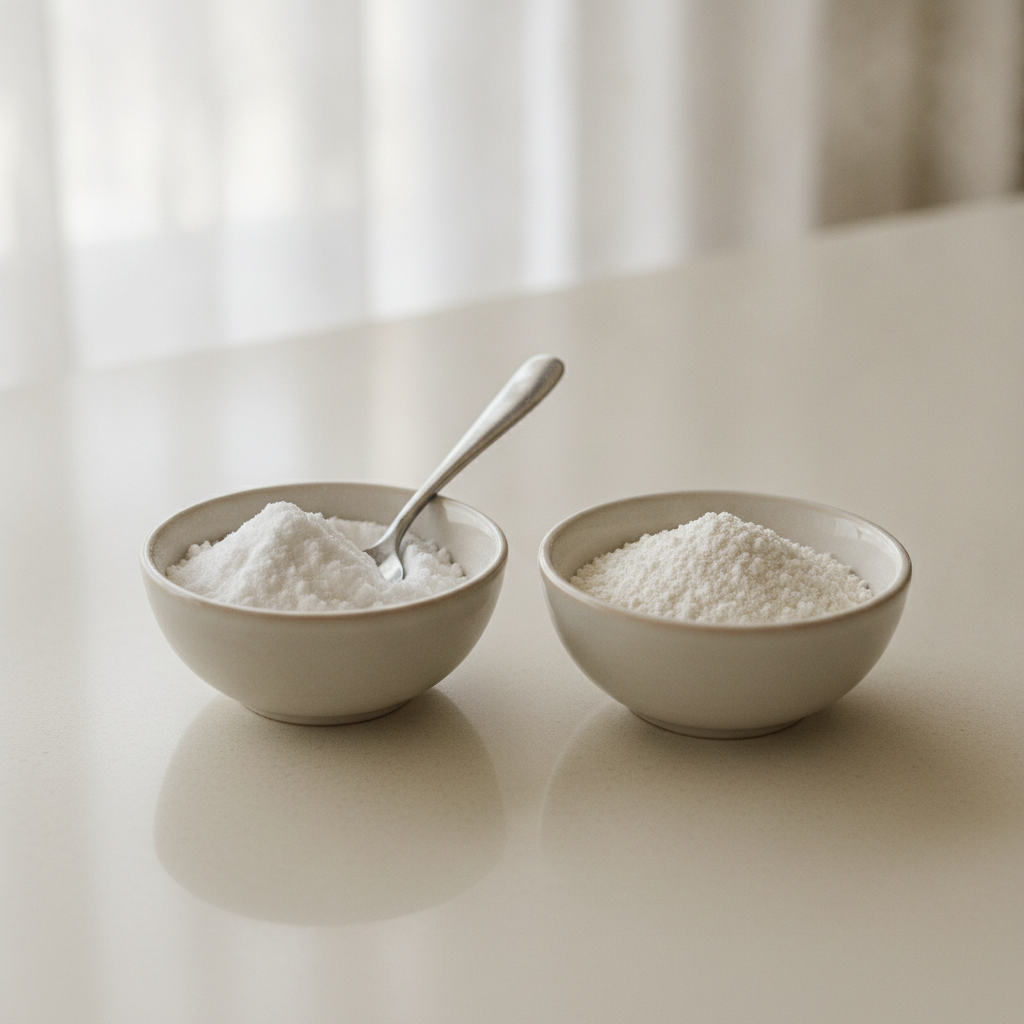
To substitute baking soda for baking powder, use about three times as much baking powder, since baking soda is a pure base needing an acid like buttermilk or lemon juice to rise, while baking powder already contains its own acid. Make homemade baking powder from soda plus cream of tartar. Too much soda tastes soapy and metallic.
You can substitute baking soda for baking powder only if you add an acid, because baking soda needs one to work; the simpler swap is the reverse, using about three times as much baking powder in place of baking soda.
- Baking soda is a pure base and needs an acid (buttermilk, yoghurt, lemon juice) to rise; baking powder already has the acid built in.
- To replace 1 tsp baking soda, use roughly 3 tsp baking powder — but expect a slightly different result.
- Too much baking soda tastes soapy and metallic, so measure carefully.
What’s the difference between baking soda and baking powder?
The difference between baking soda and baking powder comes down to one thing: acid. Baking soda (sodium bicarbonate) is a single ingredient with no acid of its own.
It only produces gas — the carbon dioxide that makes cakes rise — when it meets an acid and liquid. Without that acid, it just sits there.
Baking powder is baking soda plus a powdered acid (usually cream of tartar) and a little cornflour to keep it dry. Baking powder is self-contained, while baking soda needs a partner.
Which acids activate baking soda?
Many everyday ingredients are acidic enough to trigger the reaction. This is why recipes with these often call for baking soda specifically.
- Buttermilk and soured milk
- Plain yoghurt
- Lemon juice and vinegar
- Brown sugar, honey and treacle
- Cocoa powder (natural, not Dutch-processed)
Why does the baking soda vs baking powder choice matter?
Get it wrong and your bake won’t rise properly, or it will taste odd. Baking soda is around three to four times stronger than baking powder.
That strength is exactly why you can’t swap them spoon-for-spoon. Using baking powder where soda is needed, or vice versa, changes both the rise and the flavour.
How do you substitute baking soda for baking powder?
This is the trickier direction, because baking soda alone lacks an acid. You need to supply one so the soda can react.
The most reliable home method uses cream of tartar, which is a dry acid. It’s the same acid found inside commercial baking powder.
Make your own baking powder from baking soda
- Measure 1 part baking soda.
- Add 2 parts cream of tartar.
- Mix well and use immediately in the amount of baking powder your recipe requests.
For example, to make 1 tsp of baking powder, combine 1/4 tsp baking soda with 1/2 tsp cream of tartar. That gives you a working single-acting powder.
Mix homemade baking powder fresh each time, as it loses potency once stored. A pinch of cornflour helps if you want to keep a batch.
What if you only have baking soda and an acidic liquid?
If your recipe already contains buttermilk or yoghurt, you may be able to use baking soda directly. Use about 1/4 tsp baking soda for every 1 tsp of baking powder the recipe listed.
Then reduce or replace some liquid with an acidic one. This takes judgement, so it’s best on forgiving bakes like pancakes rather than delicate cakes.
What is the baking soda to baking powder ratio for the reverse swap?
Swapping the other way — using baking powder when you’ve run out of baking soda — is easier and needs no extra acid. Baking powder is weaker, so you simply use more.
The rule of thumb for the baking soda to baking powder ratio is use about 3 times as much baking powder to replace baking soda.
| Recipe calls for | Replace with |
|---|---|
| 1/2 tsp baking soda | 1½ tsp baking powder |
| 1 tsp baking soda | 3 tsp baking powder |
| 2 tsp baking soda | 6 tsp baking powder |
Bear in mind baking powder adds a little extra saltiness and can leave a faint tang. For precise conversions and worked examples, see our baking soda to baking powder converter.
A real-world example
Say your cookie recipe needs 1 tsp baking soda but you only have baking powder. Use 3 tsp baking powder instead.
You may want to trim any added salt slightly, since baking powder contributes some. The cookies will spread a touch less but still bake nicely.
Common mistakes to avoid
- Using too much baking soda: it tastes soapy and metallic. Fix: stick to the recipe amount, roughly 1/4 tsp per 120g (1 US cup at 236.6 ml volume) of flour as a guide.
- Swapping spoon-for-spoon: soda is far stronger than powder. Fix: apply the 1:3 ratio when replacing soda with powder.
- Forgetting the acid: baking soda won’t rise without one. Fix: add cream of tartar or an acidic liquid like buttermilk.
- Old, flat leaveners: both expire. Fix: test soda in vinegar and powder in hot water — both should fizz vigorously.
- Overmixing after adding: the gas escapes. Fix: bake promptly once the wet and dry are combined.
How can you test if your leavener is still active?
Drop 1/2 tsp baking soda into a splash of vinegar; it should bubble at once. For baking powder, stir 1 tsp into a little hot water.
No lively fizz means it’s lost its power and needs replacing. Leaveners fade over months, especially once opened.
Getting your other measurements right
Accurate leavening only helps if the rest of your amounts are correct too. Weighing flour beats scooping, which packs it down.
If you’re working from a US recipe, our cups to grams converter keeps things precise. And if you’re halving or doubling a bake, the recipe scaler adjusts leaveners for you.
For deeper background on how chemical leaveners work, the food scientists at King Arthur Baking offer trustworthy explanations.
The single most important thing to remember
Baking soda needs an acid; baking powder brings its own. If you only remember one figure, make it this: replace baking soda with three times as much baking powder.
Keep both leaveners fresh, measure with a proper spoon, and taste-test on forgiving recipes first. Small amounts make a big difference.
Have a clever swap of your own, or a question about a specific recipe? Share it in the comments — I read every one and love helping fellow bakers troubleshoot.
Try it yourself
Don’t want to do the maths by hand? Use our free tool below.
Frequently asked questions
Can I use baking soda instead of baking powder without cream of tartar? Only if your recipe already contains an acid like buttermilk, yoghurt or lemon juice. Use about 1/4 tsp baking soda per 1 tsp of baking powder needed, and ensure enough acidic liquid is present. Without any acid, baking soda won’t rise and can taste soapy.
What is the correct ratio to replace baking soda with baking powder? Use roughly three times as much baking powder as baking soda. So 1 tsp baking soda becomes 3 tsp baking powder. You may wish to reduce added salt slightly, since baking powder contributes a little of its own.
How do I make baking powder from baking soda? Mix 1 part baking soda with 2 parts cream of tartar. For 1 tsp of baking powder, combine 1/4 tsp baking soda with 1/2 tsp cream of tartar. Mix it fresh and use immediately, as homemade baking powder weakens on storage.
Why does my baking taste soapy or metallic? That flavour comes from too much baking soda, or from unreacted soda with no acid to neutralise it. Measure carefully, use the exact recipe amount, and make sure there’s enough acidic ingredient present to react with all the soda.