Stovetop to Slow Cooker: The Ultimate Conversion Guide
August 6, 2026
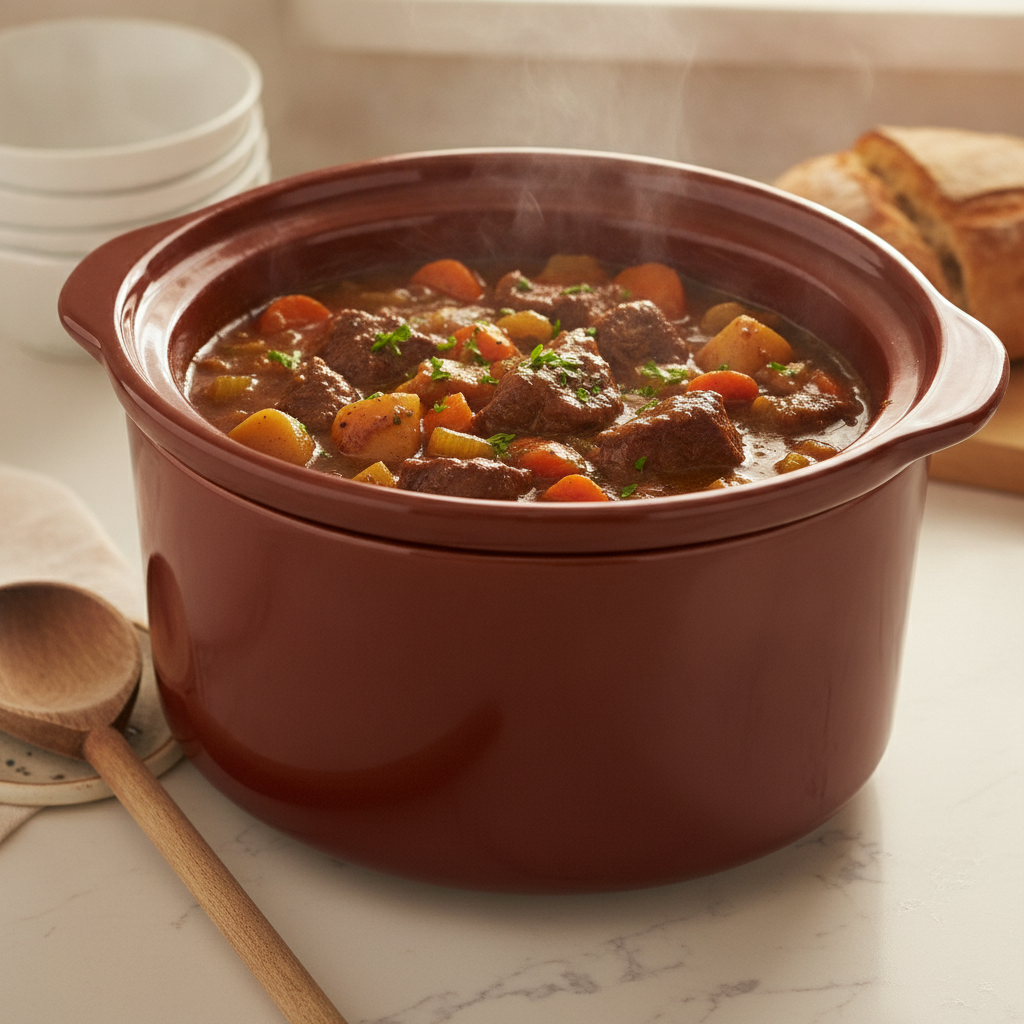
Stovetop to slow cooker conversion means cutting liquid by about a third since slow cookers barely evaporate, and stretching cook times: a 15-30 minute simmer becomes 4-6 hours on LOW or 1.5-2 hours on HIGH. Brown meat first, add dairy and fresh herbs near the end, and never lift the lid.
Stovetop to slow cooker conversion comes down to two rules: reduce the liquid by about a third, and swap a 15–30 minute simmer for 4–6 hours on LOW or 1.5–2 hours on HIGH.
- Cut the liquid by roughly one-third — slow cookers barely evaporate, so recipes end up watery otherwise.
- A short simmer (15–30 min) equals 4–6 hours on LOW or 1.5–2 hours on HIGH.
- Brown meat first, add dairy and fresh herbs near the end, and never lift the lid.
Below you’ll find the exact amounts, timing charts and the small fixes that make adapted recipes taste as good as the original.
How do you convert a stovetop recipe to a slow cooker?
The process is genuinely simple once you know the three levers: liquid, time and heat. Get those right and almost any braise, stew or casserole will work.
Follow these steps in order.
- Brown your meat and aromatics first in a pan. This builds flavour the slow cooker can’t create on its own.
- Reduce the liquid by about a third. If the original calls for 3 cups (710 ml) of stock, use roughly 2 cups (473 ml).
- Choose your setting and time using the chart below, based on the original simmer or oven time.
- Add delicate ingredients late — cream, milk, cheese, peas and fresh herbs go in during the last 20–30 minutes.
- Leave the lid alone until near the end.
The single biggest change most cooks forget is cutting the liquid.
Why do you need to reduce liquid in a slow cooker?
A slow cooker traps steam under a tight lid, so very little moisture escapes. On the hob or in the oven, that same liquid would bubble away and thicken.
Because nothing evaporates, an unadapted recipe finishes thin and watery. That’s why you reduce liquid for slow cooker recipes by roughly one-third.
A worked example
Say your beef stew recipe uses 4 cups (946 ml) of stock for a 90-minute oven braise. In the slow cooker, use about 2⅔ cups (630 ml) instead.
The meat and vegetables also release their own juices as they cook. If anything, you’ll finish with plenty of sauce.
If it does end up too loose, remove the lid for the final 30–45 minutes on HIGH, or stir in a cornflour slurry (1 tablespoon cornflour to 2 tablespoons cold water).
What are the slow cooker times for a stovetop recipe?
Use this as your working reference for converting cooking times. It covers the common cases when learning how to adapt recipes for slow cooker use.
| Original method | Slow cooker LOW | Slow cooker HIGH |
|---|---|---|
| 15–30 min simmer | 4–6 hours | 1.5–2 hours |
| 30–60 min simmer | 6–8 hours | 3–4 hours |
| 1–2 hour braise (oven or hob) | 8–10 hours | 4–6 hours |
As a rule of thumb, 1 hour on HIGH is roughly equal to 2 hours on LOW. That lets you flex a recipe around your day.
The same logic applies to oven to slow cooker conversions — go by the original cooking time, not the oven temperature. For more timings across appliances, see our slow cooker conversion guide.
Which setting should I choose?
LOW is more forgiving and better for tougher cuts like brisket or shin of beef. HIGH suits days when you want dinner in 3–4 hours.
Tough cuts and dried pulses always do better on LOW, where the connective tissue has time to break down.
Do you need to change the ingredients themselves?
Sometimes, yes. A few ingredients behave differently over long, gentle heat.
- Dairy: milk, cream, yoghurt and soft cheese can split over hours. Add in the final 20–30 minutes.
- Fresh herbs: parsley, coriander and basil lose colour and flavour. Stir in at the end; use hardy herbs like rosemary and bay early.
- Fast-cooking vegetables: peas, courgettes and spinach go in for the last 30 minutes.
- Root vegetables: cut carrots and potatoes into even chunks and place them at the bottom, near the heat.
- Wine and spirits: simmer briefly in the pan first to cook off the raw alcohol, which won’t boil away under the lid.
Add anything delicate near the end, and put anything sturdy at the bottom.
Common mistakes to avoid
These are the errors I see most often, along with the quick fix for each.
- Too much liquid. Fix: cut it by a third; the sauce should just cover the ingredients, not drown them.
- Lifting the lid to peek. Fix: leave it. Each peek loses heat and adds roughly 20–30 minutes to the cook.
- Skipping the browning step. Fix: sear meat and sweat onions first for real depth of flavour.
- Adding cream or cheese early. Fix: hold dairy back until the last half hour to prevent splitting.
- Overfilling the pot. Fix: keep it between half and two-thirds full for safe, even cooking.
- Cutting vegetables too small. Fix: larger, even chunks hold their shape over long cooking.
Can you convert baking or thickened sauces this way?
Braises, stews, soups, chillis and pulled meats convert beautifully. Delicate sauces and most baking do not.
If your recipe relies on reduction to thicken, thicken it separately at the end instead. A cornflour slurry or a beurre manié works well stirred in during the last 30 minutes.
If you’re scaling a recipe up or down at the same time, our recipe scaler keeps your ratios accurate. And when a recipe lists cups, our cups to grams converter saves guesswork.
A quick real-world conversion
Take a classic hob chicken casserole: browned thighs, onions, 2 cups (473 ml) stock and a 40-minute simmer.
To convert: brown as usual, reduce the stock to about 1⅓ cups (315 ml), and cook 6–7 hours on LOW or 3–4 hours on HIGH. Stir in cream and fresh parsley in the last 20 minutes.
The result is a richer, more tender casserole than the rushed hob version. For deeper timings on the U.S. food-safety side, the USDA safe cooking guidance is worth a look for minimum internal temperatures.
The one tip to remember
If you take away just one thing: cut the liquid by a third and trust the timing chart. Everything else is fine-tuning.
Once you’ve done a couple of conversions, it becomes second nature — and your slow cooker will earn its place on the worktop. Have a recipe you’re trying to adapt, or a tip that’s worked for you? Share it in the comments below; I read and reply to every one.
Try it yourself
Don’t want to do the maths by hand? Use our free tool below.
Frequently asked questions
How much should I reduce the liquid when converting to a slow cooker? Reduce it by about one-third. Slow cookers barely evaporate, so a recipe using 3 cups (710 ml) of stock needs only around 2 cups (473 ml). If it still finishes too thin, cook uncovered for the last 30–45 minutes or stir in a cornflour slurry.
How long is a 20-minute simmer in a slow cooker? A 15–30 minute simmer translates to roughly 4–6 hours on LOW or 1.5–2 hours on HIGH. LOW is more forgiving for tougher cuts, while HIGH is handy when you need dinner sooner.
Why can't I lift the lid while it's cooking? Each time you lift the lid you release trapped heat and steam, adding around 20–30 minutes to the total cook. Resist peeking until the final stage, when you’re checking doneness or thickening the sauce.
Can I add cream or milk to a slow cooker recipe? Yes, but add dairy in the last 20–30 minutes. Milk, cream, yoghurt and soft cheese can split or curdle over long, gentle heat, so stirring them in near the end keeps the sauce smooth.