Cup Fractions to Grams: ½, ⅓, ¼ and 1½ Cups by Ingredient
August 3, 2026
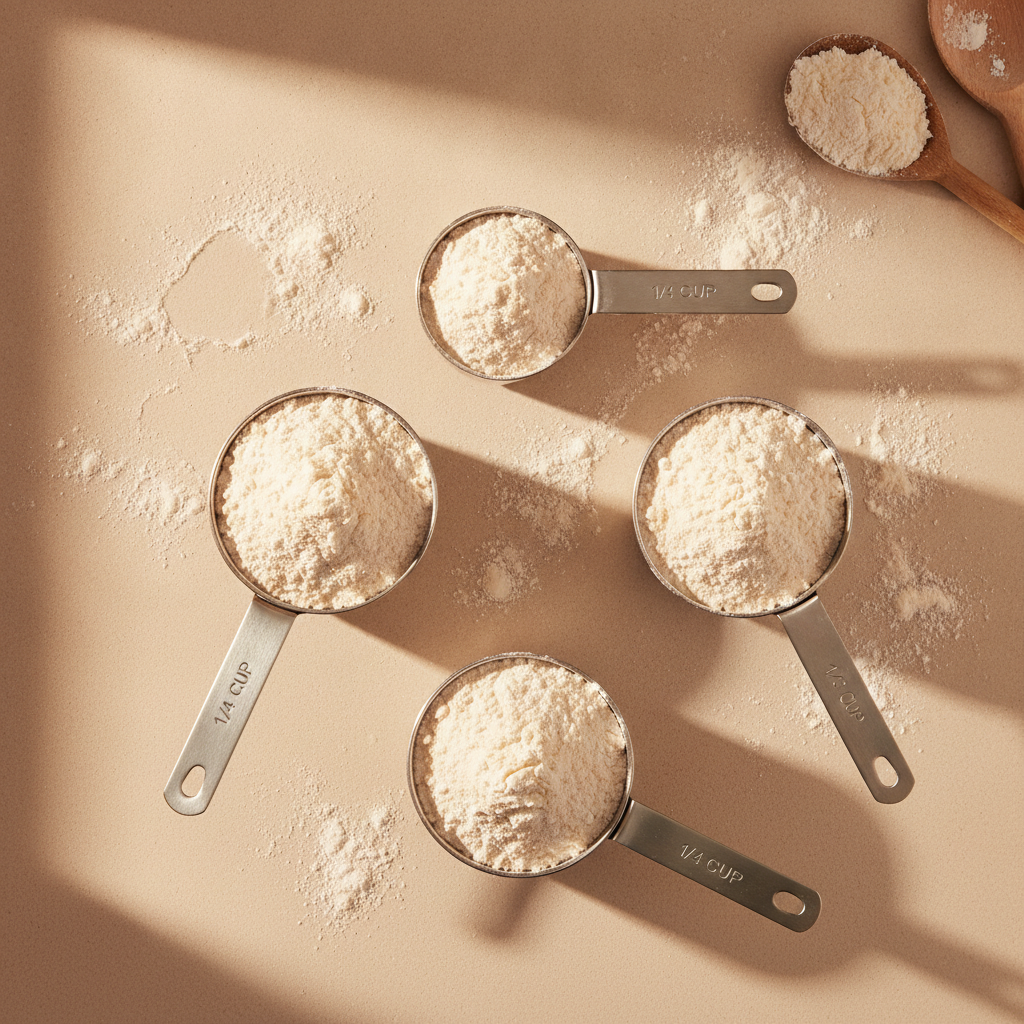
Cup fractions to grams depend entirely on the ingredient: a half cup of plain flour is about 63 g, half a cup of sugar is 100 g, and half a cup of butter is 113 g. The same fraction, very different weights.
- Grams differ by ingredient because density differs — flour is light and fluffy, sugar and butter are dense.
- Use the chart below for exact ¼, ⅓, ½, ⅔, ¾, 1 and 1½ cup weights.
- Weighing on a digital scale beats measuring fractional cups every single time.
Odd fractions like a third of a cup are where measuring cups get fiddly. This guide gives you reliable numbers and a faster way to work.
How do I convert cup fractions to grams?
To convert cup fractions to grams, take the full-cup gram weight for your ingredient and multiply by the fraction. A quarter cup is simply a quarter of the full-cup weight.
The tricky part is that no single number works for every ingredient. Flour, sugar and butter all weigh differently at the same volume.
For example, one US cup of plain flour is about 125 g, but one cup of granulated sugar is 200 g. That is why you can never rely on a generic “1 cup = X grams” rule.
Cup fractions to grams chart: flour, sugar and butter
Here are the exact gram values for the three ingredients home bakers reach for most. These are rounded to sensible kitchen figures.
| Cup fraction | Plain flour | Granulated sugar | Butter |
|---|---|---|---|
| ¼ cup | 31 g | 50 g | 57 g |
| ⅓ cup | 42 g | 67 g | 76 g |
| ½ cup | 63 g | 100 g | 113 g |
| ⅔ cup | 83 g | 133 g | 151 g |
| ¾ cup | 94 g | 150 g | 170 g |
| 1 cup | 125 g | 200 g | 227 g |
| 1½ cups | 188 g | 300 g | 340 g |
Bookmark this table — it covers the vast majority of everyday baking needs. For other ingredients, our full cups to grams converter handles icing sugar, brown sugar, oats and more.
Why is half a cup in grams different for each ingredient?
It comes down to density. The same cup holds the same volume, but heavier ingredients pack more grams into that space.
Half a cup in grams is 63 g for flour but 113 g for butter — nearly double. Butter is a solid, dense fat, while flour traps air between fine particles.
This is exactly why a quarter cup in grams (¼ cup grams) also varies: 31 g of flour versus 57 g of butter for the identical measure.
How do I measure a third or half cup accurately?
If you must use cups, technique matters enormously. Poorly filled cups are the biggest source of baking errors.
- Flour: spoon it loosely into the cup, then level with a straight edge. Never scoop straight from the bag — it compacts and adds up to 20% extra.
- Sugar: scoop and level; sugar does not compact like flour, so it is more forgiving.
- Butter: use the wrapper markings, or press soft butter firmly into the cup to remove air pockets.
A third cup in grams is where errors creep in, because ⅓ measures are shallow and easy to overfill. When precision matters, weigh instead.
Why does weighing beat fractional cups?
Weighing removes guesswork completely. A scale gives you the same result every time, regardless of how you scoop or pack.
Getting 1 1/2 cups in grams right by volume means filling and levelling three separate half cups — three chances to err. On a scale, 188 g of flour is 188 g, full stop.
Weighing is faster, cleaner and more accurate, especially when scaling recipes up or down. If you are adjusting quantities, our recipe scaler does the maths for you.
A real-world example
Say a shortbread recipe calls for 1½ cups plain flour, ½ cup sugar and ¾ cup butter. In grams, that is 188 g flour, 100 g sugar and 170 g butter.
Weigh those three numbers into one bowl on a scale and you are ready in seconds — no rinsing three different cups between ingredients.
Common mistakes to avoid
- Using one gram figure for everything. Fix: always match the number to the ingredient, as densities differ hugely.
- Scooping flour from the bag. Fix: spoon and level, or better still, weigh it.
- Packing sugar like brown sugar. Fix: granulated and caster sugar should sit loose, not pressed.
- Guessing butter by eye. Fix: use wrapper markings or weigh it — 227 g equals one full cup. See our butter converter for sticks and tablespoons.
- Ignoring cup standards. Fix: a US cup is 236.6 ml; a UK/metric cup is 250 ml, so check which your recipe uses.
What about US versus metric cups?
Recipes from the US use a 236.6 ml cup, while Australian and some British recipes use a 250 ml cup. The chart above is based on the US cup.
Always confirm which cup your recipe assumes before converting. For a full reference across ingredients, the King Arthur Baking ingredient weight chart is a genuinely reliable source.
If your recipe mixes cups, ounces and grams, keep our recipe conversion chart handy for quick lookups.
The one tip to remember
If you take away nothing else: a fraction of a cup is a volume, not a weight, so the grams always depend on the ingredient. Reach for your scale whenever accuracy counts.
Got a favourite ingredient you convert often, or a fraction that always trips you up? Share your tips or ask a question in the comments — we are happy to help you get it right.
Try it yourself
Don’t want to do the maths by hand? Use our free tool below.
Frequently asked questions
How many grams is half a cup of flour? Half a cup of plain flour is about 63 g, based on a full US cup of 125 g. Spoon and level the flour, or weigh it for best accuracy.
Is a quarter cup in grams the same for sugar and butter? No. A quarter cup of granulated sugar is about 50 g, while a quarter cup of butter is about 57 g. Butter is denser, so it weighs more at the same volume.
What is 1 1/2 cups in grams? It depends on the ingredient: 1½ cups is roughly 188 g of plain flour, 300 g of granulated sugar, or 340 g of butter.
Why should I weigh instead of using fractional cup measures? Weighing gives the same result every time and avoids errors from packing or overfilling shallow ⅓ and ¼ cups. It is faster and cleaner, especially when scaling recipes.